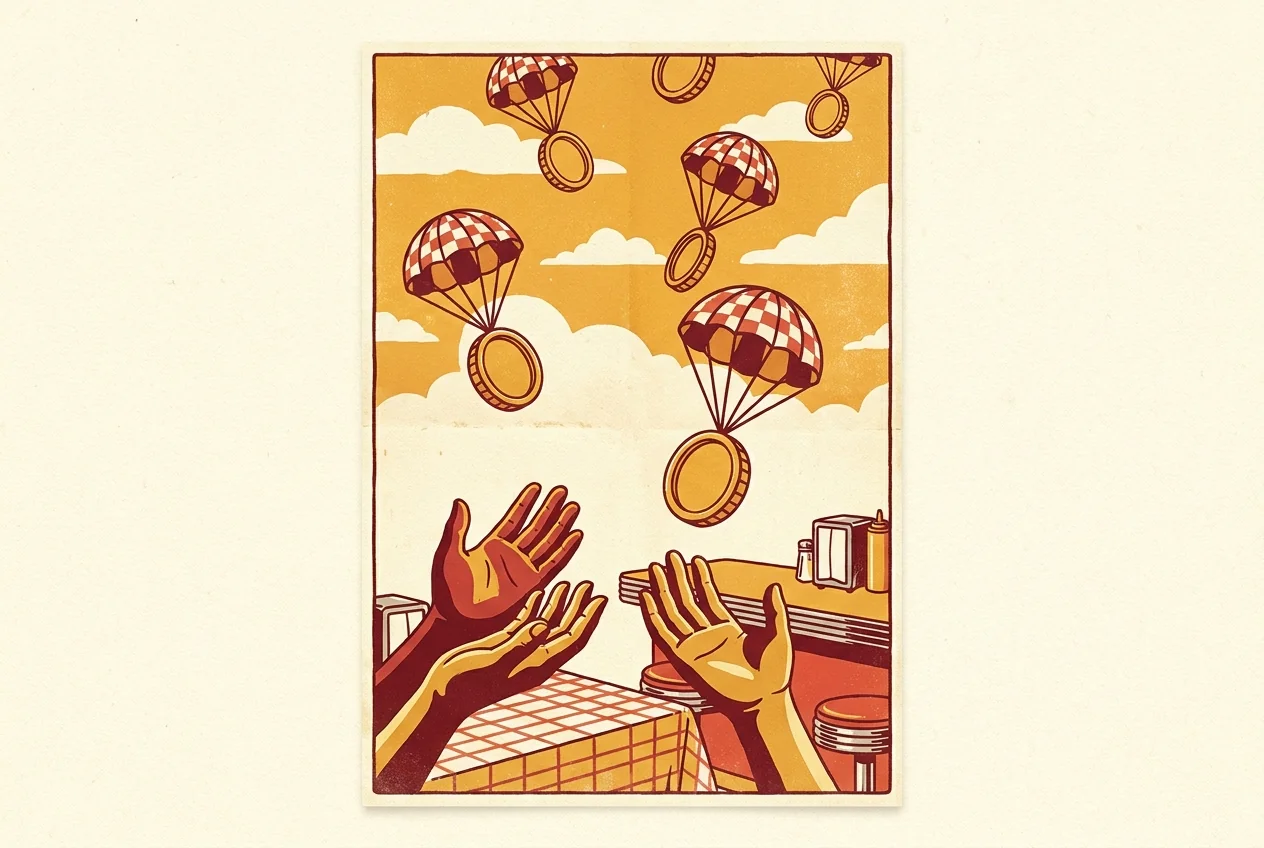
A crypto airdrop is a giveaway. A project sends free tokens — its own digital coins — straight to people's wallet addresses. No purchase. You wake up, check your wallet, and there's something new in it. That's the dream version, anyway. The real story has more moving parts, so let's walk through it.
The basic idea
A token is a digital asset that lives on a blockchain, which is a shared public ledger — think of it as a notebook thousands of computers keep in sync. A wallet is the app that holds the keys to your spot in that notebook. An airdrop is when a project writes new entries into the notebook that say: these addresses now hold our token.
Who gets picked? Usually people who did something the project values. Maybe you used their app before it was popular. Maybe you tested an early version. Maybe you held a certain coin on a certain date — a moment the project records is called a snapshot. Do the thing before the snapshot, and you qualify without even knowing it.
Sizes vary wildly, too. Some drops hand every qualifying address the same fixed amount. Others scale with how much you used the product, so heavy users get several times more. A few even add loyalty bonuses for people who held earlier drops instead of selling on day one.
Why would anyone give tokens away?
It sounds too generous to be real, but there's cold logic behind it.
- Rewarding early users. People who tried the product early took a risk. Tokens say thanks.
- Spreading ownership. Many tokens carry voting power over the project. A wide airdrop puts that power in many hands instead of a few.
- Marketing. Nothing gets attention like free money. A big airdrop makes headlines and fills group chats for weeks.
- Bootstrapping activity. New holders try the product, trade the token, and tell friends.
Some campaigns lean so hard on that last point that the giveaway becomes the whole product. That's where referral airdrops come in — a special breed we cover separately, partly because this very website ran one in 2021.
Famous airdrops and what they paid
A few drops became legends. Here's what a typical recipient had to do, and roughly what the tokens were worth when they launched. Every figure is approximate — prices moved fast, and each person's amount varied.
| Airdrop | Year | What you did to qualify | Rough value at launch |
|---|---|---|---|
| Uniswap (UNI) | 2020 | Used the Uniswap exchange at least once before the snapshot | 400 UNI, about $1,200 (approximate) |
| Ethereum Name Service (ENS) | 2021 | Registered a .eth name before the snapshot | Often about $5,000 or more (approximate) |
| Arbitrum (ARB) | 2023 | Bridged funds and made transactions on the Arbitrum network | Commonly about $1,000–$2,000 (approximate) |
| Jito (JTO) | 2023 | Staked SOL through Jito's liquid staking product | Even small users got roughly $10,000 (approximate) |
Reading that table, it's tempting to think airdrops are a cheat code. They're not. For every UNI there are hundreds of drops worth pocket change, and thousands of "airdrops" that were never real at all. Our airdrop value calculator helps you do the sober math on any drop: tokens times price, minus gas and your time.
The catch behind "free"
Even honest airdrops have costs. Claiming usually means sending a transaction, and transactions cost gas — a network fee, often a few dollars. Qualifying can take hours of activity. In many countries, airdropped tokens count as taxable income the moment you receive them, so keep records. And the biggest cost is risk: fake airdrops exist purely to steal.
The scam pattern is simple. A site promises free tokens, then asks you to "verify your wallet" by typing your seed phrase — the secret recovery words that control everything you own. Hand those over and your wallet is emptied in minutes. A real airdrop never asks for your seed phrase, and never asks you to send crypto first to "activate" your reward. Those two rules alone dodge most traps. For the full checklist, see how to find airdrops that aren't traps.
So what is an airdrop, really?
It's a marketing budget with a parachute. Sometimes it lands on deserving early users and genuinely changes their week. Sometimes it's confetti — pretty for a moment, worthless on the floor. And sometimes it's cheese in a mousetrap. Your job as a reader isn't to catch every drop; it's to understand the machine well enough to know which kind is falling on you. Set up a wallet safely first — our MetaMask and Polygon guide walks through it — keep your seed phrase offline, and treat every "free" token as a claim to verify, not a gift to trust.