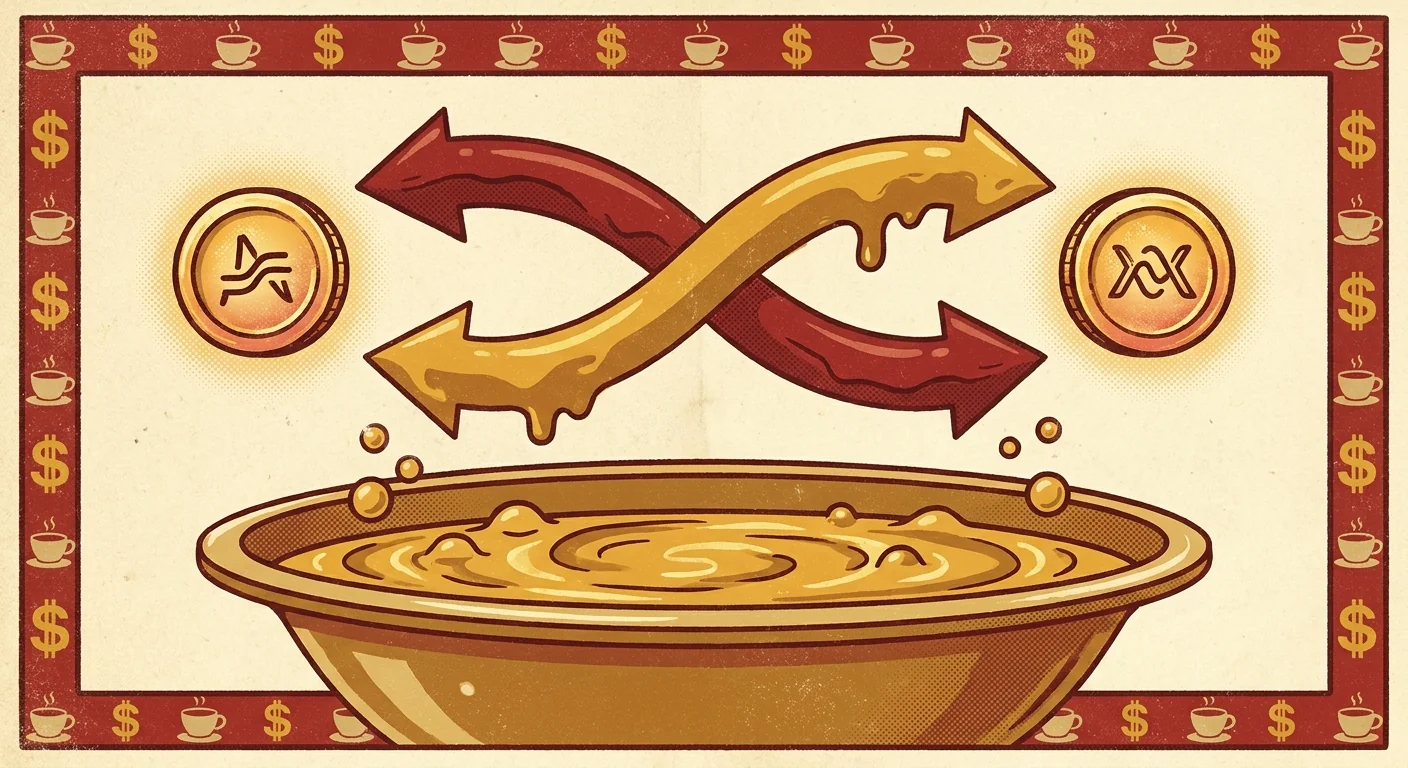
Swap is one of those crypto words that sounds simple. Click a button, get a different token. Under the button sits a small on-chain auction with fees, slippage, and a large scam surface if you are not careful about which token you are actually trading. This page walks through the safe way to swap.
What a swap actually is
On a decentralised exchange (DEX) you swap through a liquidity pool. A pool is a smart contract holding a supply of two tokens (or sometimes more). When you deposit token A into the pool, the pool sends you the right amount of token B based on the current ratio. Prices update by that ratio — buying makes the token you want more scarce and its price rises inside the pool.
Because you trade against the pool, not against a person, you always get some fill. But the price depends on how much you buy and how deep the pool is. Small trades in a big pool are cheap. Big trades in a small pool are painful.
Slippage and price impact
Two numbers on every swap screen deserve attention.
| Term | What it means | Sensible target |
|---|---|---|
| Slippage tolerance | How much worse than the quote you accept before the swap fails | 0.1–0.5% for major pairs; higher for volatile tokens |
| Price impact | How much your trade moves the pool price | Under 1% for a comfortable swap |
| Fee | Pool's cut of the trade, paid to liquidity providers | 0.05–0.3% is normal on major DEXs |
| Network gas | Fee paid to the chain to include the transaction | Whatever the chain charges; watch it on small trades |
Bad slippage settings are how MEV bots eat retail trades on Ethereum. Setting slippage very high just to make the swap go through invites a sandwich attack: the bot buys before you and sells after you, pocketing the difference. Keep slippage tight; if the swap fails, break it into smaller pieces or wait.
The fake token problem
Anybody can deploy a token called USDT or MATIC on any EVM chain. The name and symbol are just labels. The real token lives at a specific contract address. Wallets and DEX interfaces try to warn you when a token contract is unofficial, but the warning is easy to miss when the token is trending in a chat.
Rules that never let you down:
- Copy the contract address of the token from its official site or the project's verified account.
- Paste it into the swap interface's token selector, not the search bar.
- Compare the resulting token page with a block explorer to confirm the contract is verified and the deployer matches.
- Ignore search-ad results linking to swap pages; they often point at fake token pairs.
Our companion pages on how to find airdrops that aren't traps and airdrop scams cover the same URL-and-address discipline.
Pick the right chain for the swap
Gas is the difference between a good swap and a bad one on small amounts.
- On Ethereum mainnet, a simple token swap costs $5–$40 depending on load. A $50 trade is not worth doing.
- On Polygon, Base, or Arbitrum, the same swap can cost cents. A $50 trade makes sense.
- On Solana, swaps are almost free but network congestion can cause partial failures. Try during quiet times.
If a token lives on multiple chains, prefer the cheap chain for small experiments. Move to mainnet only for large swaps where the fixed gas is small relative to the trade.
A safe swap in five clicks
Once you know the shape, a safe swap is fast.
- Open the DEX you know. Verify the URL.
- Load both token contract addresses from their official sources. Reject any tokens the interface flags as unofficial.
- Set slippage low. Watch price impact.
- If the token is new, approve only the amount you plan to swap, not unlimited.
- Confirm in the wallet, read the transaction, and sign.
If the swap succeeds, the destination token arrives in your wallet within seconds on cheap chains, a minute or two on Ethereum. If it fails, look at the reason in the wallet — usually slippage was too tight, or the pool moved. Retry with a smaller amount or a different route.
The swap button in perspective
Every swap is a small transaction with a real cost. Slippage matters. Contract addresses matter. Chain choice matters. Do those three things right and every swap you make is safe and cheap enough to be a routine tool. Do them wrong and you feed MEV bots, fake tokens, or worse — a well-placed drainer contract disguised as a DEX. Neither outcome is dramatic in the moment. The difference is a habit of checking twice, and it pays back every single time you use it. For the wider wallet story, see hot wallets vs cold wallets.